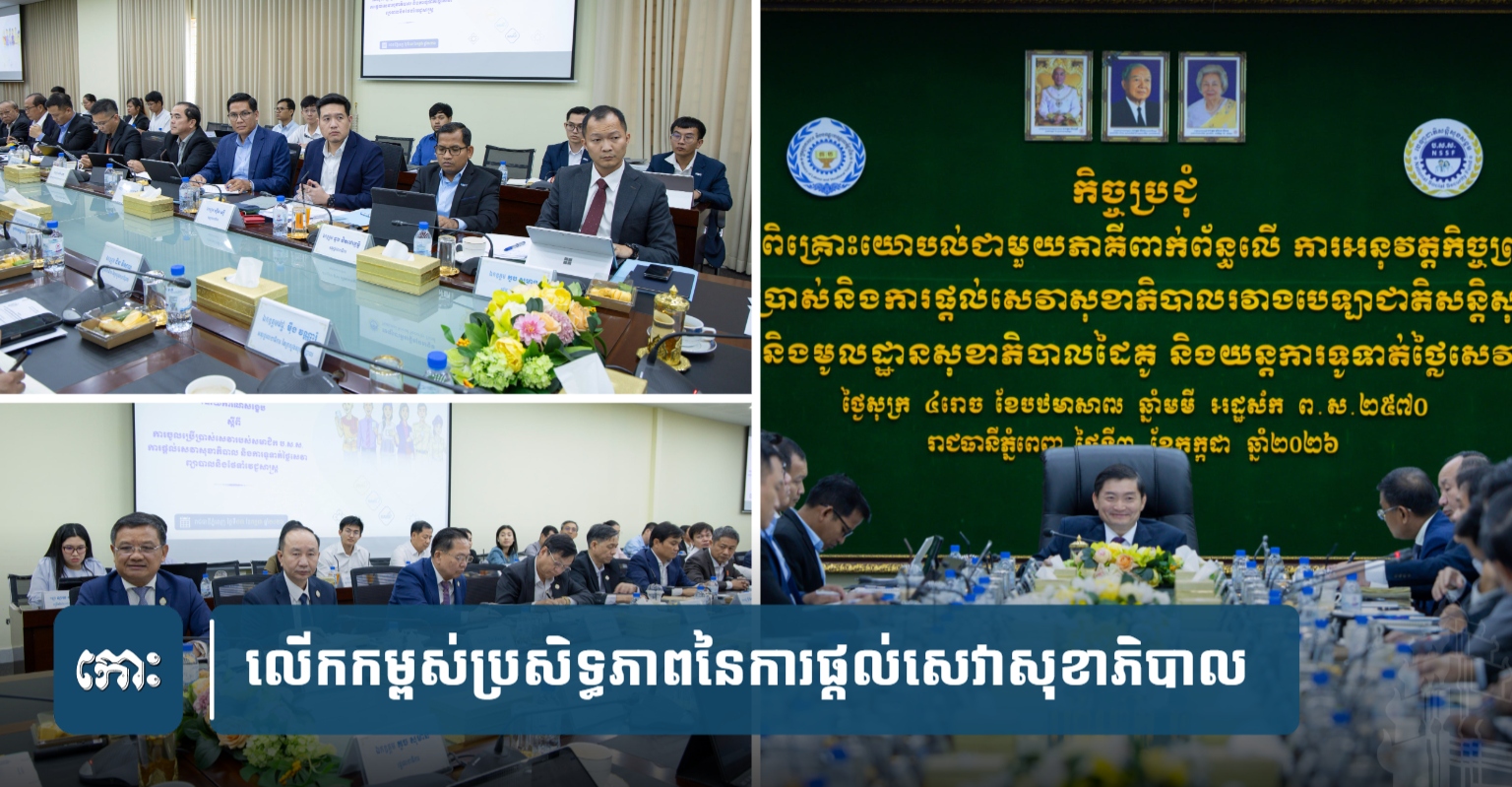
Cambodia Convenes Meeting to Enhance Social Security Healthcare Services
Cambodia's Ministry of Labour and Vocational Training held a consultation meeting with stakeholders to improve the efficiency of healthcare service provision and payment mechanisms for the National Social Security Fund (NSSF). The aim is to reduce healthcare costs and enhance service quality through strengthened collaboration with public and private healthcare providers.
Phnom Penh: H.E. Heng Sour, Minister of Labour and Vocational Training and Chairman of the National Social Security Fund (NSSF) Board, presided over a consultation meeting with relevant stakeholders on enhancing the efficiency of healthcare service provision and payment mechanisms for NSSF members. The meeting, held on July 3, 2024, at the Ministry's headquarters, was attended by over 80 participants from the Ministry of Labour, Ministry of Health, Medical Council, NSSF, the General Secretariat of the National Social Protection Council, the National Agency for Expenditure Verification, the Social Security Fund Regulator, and partner healthcare facilities. The crucial meeting aimed to review the system for providing healthcare services, exchange views, and gather input to find solutions for challenges related to the implementation of agreements on the use and provision of healthcare services between the NSSF of the Ministry of Labour and Vocational Training and partner healthcare bases, as well as to determine appropriate service fee payment mechanisms. This is particularly important as the number of service users at partner hospitals, both public and private, continues to increase, especially at national-level hospitals. H.E. Heng Sour emphasized the Royal Government's high commitment to providing NSSF services to its members, covering work-related risks, healthcare, and pensions. He noted that these services are becoming increasingly popular and attracting more citizens, particularly in the healthcare sector. Furthermore, the government envisions expanding NSSF coverage sustainably, based on principles of equity and equality, without solely relying on the national budget. The Minister stated that NSSF members are currently showing a trend towards trusting and utilizing services at national-level hospitals. Concurrently, he highlighted the necessity of jointly seeking methods to encourage and motivate NSSF members to shift towards using services at local facilities, such as district or provincial referral hospitals. This approach, he explained, would help alleviate the burden on national hospitals while providing local hospitals with revenue to strengthen their capacity. This includes improvements in infrastructure, specialized equipment, human resources, consultation rooms, and inpatient beds, enabling them to better meet the needs of NSSF members. Following a presentation by H.E. Khun Channarith, Deputy Director-General of NSSF, on the implementation of agreements and service provision between NSSF and partner healthcare facilities, and the fee payment mechanism, the meeting engaged in a lively discussion. Important suggestions were put forth to address the challenges, aligning with the government's considerations. The participants expressed gratitude to the Ministry of Labour for organizing the meeting to inform them about the NSSF's situation and for supporting H.E. Heng Sour's strategic and forward-looking remarks. H.E. Heng Sour expressed his deep gratitude to the attendees and highly valued the fruitful discussions, deeming the input received as valuable for implementation. He encouraged the participants to continue their collaboration to achieve the common goal of maintaining the sustainability of NSSF operations and promoting the health of the Cambodian people. Source: Koh Santepheap Khmer
多角的分析
カンボジアにおける社会保障医療サービスの拡充は、国民の医療アクセス向上と健康増進に不可欠です。今回の協議会は、NSSF(社会保障基金)の医療サービス提供と支払いメカニズムの効率化を目指すものであり、長期的には国民の医療費負担軽減と、医療従事者のモチベーション向上に繋がる可能性があります。特に、地方病院への利用促進は、医療インフラの格差是正と地域経済の活性化にも寄与すると考えられます。しかし、地方病院の能力向上には、専門的な医療機器や人材の育成・確保が不可欠であり、これには継続的な投資が必要です。
NSSFの医療サービス強化は、カンボジア国内の医療インフラへの投資機会を創出する可能性があります。特に、地方病院の設備拡充や専門人材育成への投資は、長期的な視点で見れば有望な分野となり得ます。また、医療サービスの質向上は、国内の医療ツーリズムの発展にも寄与する可能性があり、関連産業への投資も期待されます。しかし、投資判断においては、政府の財政支援の持続性や、地方病院の運営能力、そして国民の医療サービス利用動向を慎重に見極める必要があります。
今回の協議会は、カンボジア国民、特にNSSF会員の医療アクセス改善に向けた重要な一歩です。ヘン・スア大臣が指摘したように、国営病院への集中を緩和し、地方の医療機関への利用を促すことは、医療サービスの地域格差是正に繋がります。これにより、地方に住む人々もより質の高い医療を受けやすくなることが期待されます。しかし、地方病院の設備や人材の不足が解消されない場合、医療格差は依然として残り、国民の不満につながる可能性があります。また、NSSF会員が地方病院を信頼し、利用を拡大するためには、サービス内容の透明化や、患者への丁寧な対応が求められます。
NSSF会員であるカンボジア市民にとって、今回の協議会は、将来的に医療サービスへのアクセスが改善され、医療費の負担が軽減される可能性を示唆しています。特に、地方に住む人々にとっては、これまでアクセスが難しかった質の高い医療が身近になることが期待されます。しかし、地方病院の設備や人材が十分に整わないまま利用を促された場合、期待通りの医療を受けられないリスクも考えられます。市民としては、NSSFのサービスがより身近で、信頼できるものになることを望んでいます。
背景・歴史的文脈
カンボジアでは、社会保障制度の拡充が国家的な課題となっており、特に国民皆保険制度の確立に向けた取り組みが進められています。2010年に設立された社会保障基金(NSSF)は、労働災害補償、医療、年金などの社会保障サービスを提供していますが、そのサービス提供範囲や質には地域間・施設間の格差が存在します。近年、政府は医療インフラの改善とサービス提供の効率化を重視しており、特に地方部における医療アクセスの向上は、国民生活の安定と経済発展の基盤として不可欠と認識されています。今回の協議会は、こうした背景のもと、NSSFの医療サービス提供体制を強化し、国民の医療ニーズに一層応えるための具体的な方策を模索するものです。
原文ソース
Koh Santepheap Khmer