General articles are free for 24 hours after publish.
Cambodia Seeks UN Mediation for Maritime Border Dispute with Thailand
Cambodia has engaged with the UNCLOS Conciliation Commission for the first time to resolve its long-standing maritime border dispute with Thailand. The meeting, held in Singapore from September 14, 2026, marks a new step towards a peaceful resolution initiated by Cambodia after bilateral negotiations stalled.
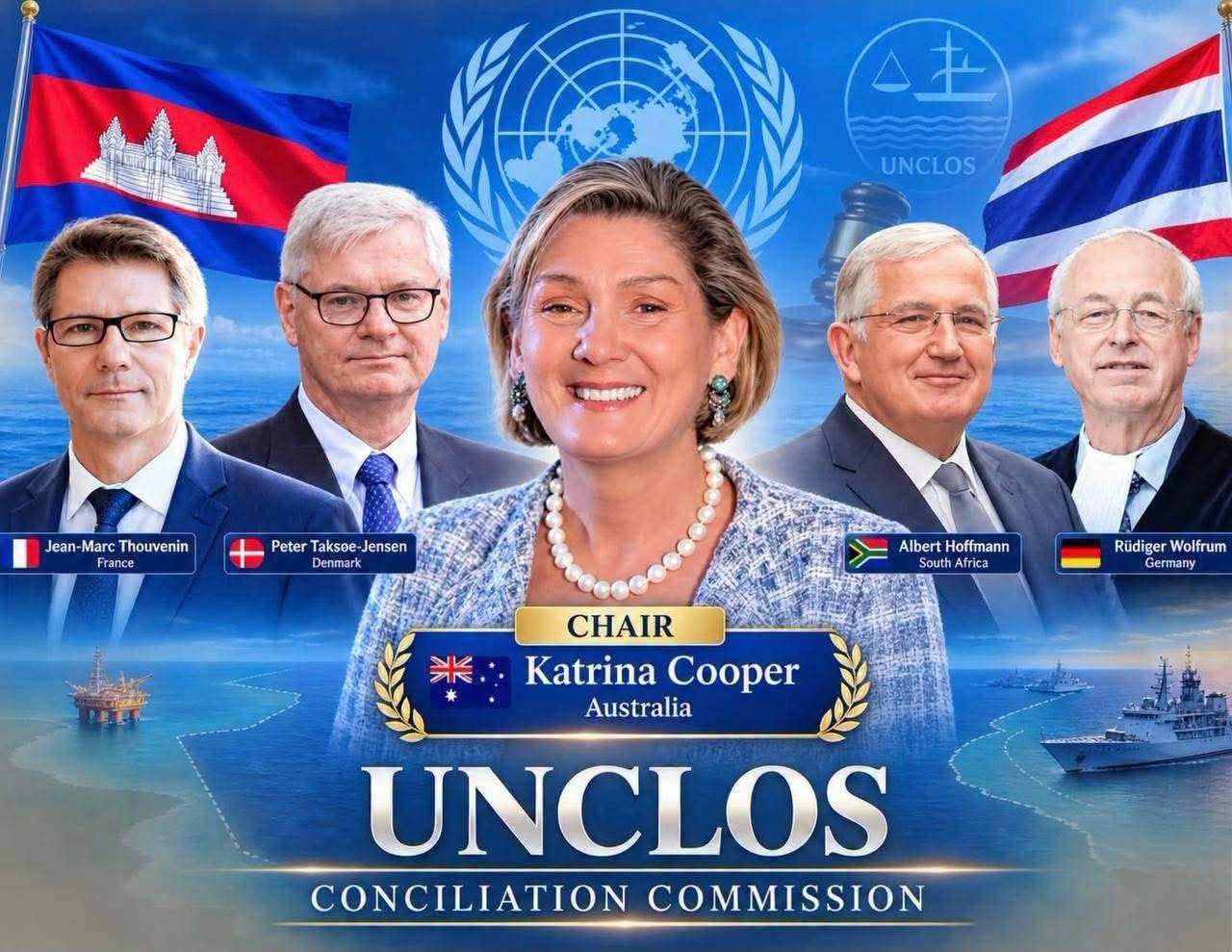
Cambodia has engaged with the United Nations Convention on the Law of the Sea (UNCLOS) Conciliation Commission for the first time to resolve its long-standing maritime border dispute with Thailand. On September 13, 2026, Deputy Prime Minister and Minister of Foreign Affairs Prak Sokhonn, accompanied by Deputy Prime Minister and Minister of Justice Keut Rith, departed for Singapore to participate in the inaugural meeting of the commission, scheduled from September 14 to 15, 2026. The Conciliation Commission, established under Annex V of UNCLOS, will hold its first meeting with Cambodia and Thailand in Singapore from September 14 to 16, 2026. The opening speeches by both parties are scheduled for Tuesday, September 15, at 8:00 AM Cambodia time (9:00 AM Singapore time) and will be publicly broadcast live in Khmer, English, and Thai. Cambodia's opening statement will be delivered by Deputy Prime Minister Prak Sokhonn. The Cambodian Ministry of Foreign Affairs views this meeting as another significant event in Cambodia's peaceful initiative to resolve the maritime dispute between the two countries. Cambodia has turned to conciliation after Thailand unilaterally terminated the bilateral agreement framework that served as the basis for negotiations on overlapping maritime claims for over two decades. The Ministry of Foreign Affairs highlighted that forced conciliation under Annex V of UNCLOS is not an adjudicatory process. Instead, a neutral commission assists both parties in seeking a peaceful resolution. This mechanism was successfully used previously between Timor-Leste and Australia, leading to the signing of a maritime boundary treaty between the two countries in 2018. Cambodia hopes this process will help Cambodia and Thailand reach a just and lasting solution to their maritime border dispute, including opportunities to explore the abundant oil and gas resources in the disputed area for the benefit of both nations during a critical time for regional energy security. Cambodia firmly believes that international law is the cornerstone for peacefully resolving disputes between states and enters this process in good faith and a spirit of cooperation, with full confidence in the Conciliation Commission. The UNCLOS Conciliation Commission comprises five independent conciliators. Cambodia has appointed Ambassador Peter Taksøe-Jensen from Denmark and Professor Jean-Marc Thouvenin from France. Thailand has appointed Judge Rüdiger Wolfrum from Germany and Albert Hoffmann from South Africa. Ms. Katrina Cooper from Australia has been selected as the Chairperson of the Conciliation Commission. The resort to forced conciliation was prompted by Thailand's revocation of the 2001 Memorandum of Understanding on the Overlapping Claims Area (MOCA), which was a bilateral mechanism for resolving maritime issues. Following the Thai government's cancellation of the MoU on May 5, 2026, the Cambodian government, led by Prime Minister Hun Manet, with the initiative of former Prime Minister Hun Sen, moved swiftly towards the United Nations, which Cambodia considers a golden opportunity to resolve this persistent issue. After deciding to approach the United Nations, Cambodia did not delay the procedure and promptly selected international legal experts to represent its case. "Forced conciliation" implies an obligation to participate, whether willing or not, thus compelling Thailand to engage with Cambodia under the UNCLOS mechanism, even if not entirely pleased with it. Source: CPP Cambodia
Original source
CPP Cambodia