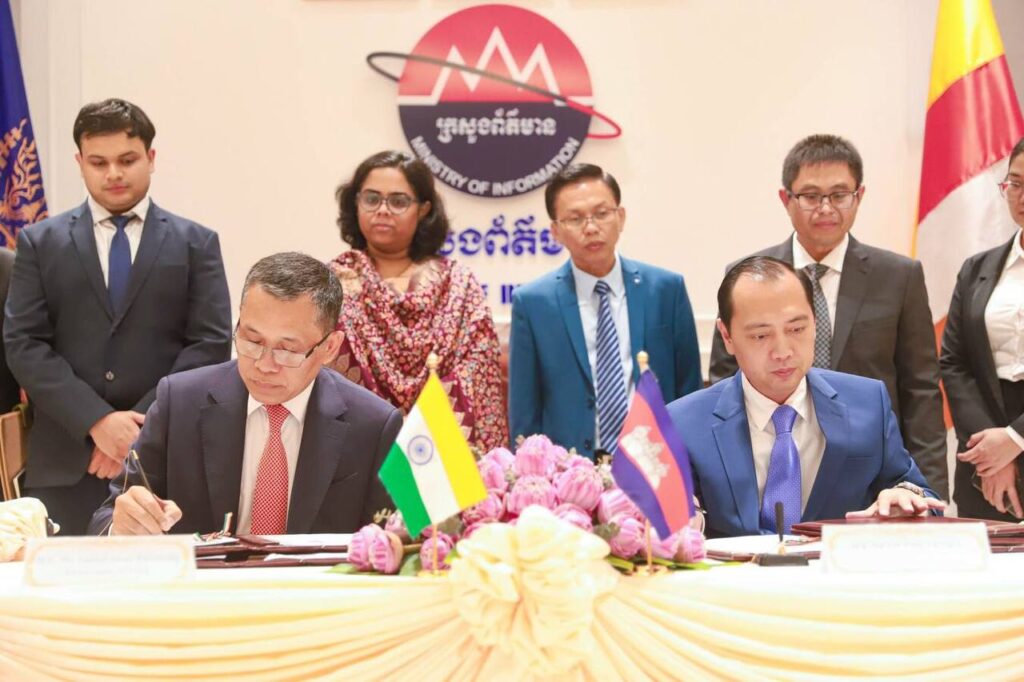
India Launches Two New Projects in Cambodia to Support Farmers and Poor Students
India has signed two new Quick Impact Projects (QIPs) in Cambodia's Kratie province, focusing on climate-resilient honey production for farmers and providing bicycles to underprivileged students. These initiatives are implemented under the Mekong-Ganges Cooperation (MGC) framework.
Cambodia and India have signed two Memoranda of Understanding (MoUs) to implement Quick Impact Projects (QIPs) in Kratie province under the Mekong-Ganges Cooperation (MGC) framework. These projects aim to develop climate-resilient smart beekeeping techniques for smallholder farmers and provide bicycles to 200 underprivileged students to facilitate their school commute and reduce dropout rates. The signing ceremony took place on July 10, 2026, between the Ministry of Foreign Affairs of the Republic of India, represented by the Indian Embassy in Cambodia, and the Ministry of Information of Cambodia. The event was presided over by Mr. Net Pheaktra, Minister of Information, and Mr. Vanlalvawna Bawitlung, Ambassador of India to Cambodia. According to a joint press release, both projects are intended to bring direct benefits to rural communities in O'Kreang Sen Chey district, Kratie province. The "Climate-Resilient Smart Beekeeping for Smallholder Farmers" project will provide vocational training, materials, and technical equipment to 30 smallholder farmers, with priority given to women and youth. It will also establish 10 model apiaries and promote climate-resilient agricultural practices, aiming to increase household income by at least 30 percent through the production of honey and related products. Meanwhile, the "Community Support for Education - Phase 2" project will distribute bicycles, safety helmets, and reusable water bottles to 200 financially disadvantaged students in grades 5 and 6. This project is a continuation of its first phase, with the objectives of enhancing school enrollment, reducing dropout rates, improving travel safety, and promoting environmental awareness. The statement emphasized that Cambodia remains a valued partner for India under its "Act East Policy" and the MGC framework. India annually implements 10 QIPs in Cambodia across priority sectors such as education, health, women's empowerment, sanitation, agriculture, and climate change resilience. To date, a total of 72 QIPs have been approved, with 55 successfully completed and 17 others currently in the implementation phase. All these projects align with the development priorities set by the Royal Government of Cambodia. These new initiatives clearly reflect the strong and growing development partnership between India and Cambodia, focusing on delivering direct benefits to local populations, human resource development, and promoting sustainable livelihoods. Source: Kampuchea Thmey Local
多角的分析
インドからの新たな支援は、カンボジアの地方経済、特に農村部における収入源の多様化に貢献する可能性がある。スマート養蜂プロジェクトは、小規模農家の生産性向上と市場へのアクセス改善を通じて、直接的な経済的恩恵をもたらすことが期待される。蜂蜜生産の増加は、輸出収入の潜在的な増加にもつながりうる。しかし、その持続可能性は、技術移転の質、市場の需要、そして気候変動の影響への適応能力にかかっている。
この種の小規模な開発プロジェクトは、直接的な投資機会を創出するものではないが、カンボジアの農村部におけるインフラと人的資本の改善に間接的に貢献する。これは、将来的に農業関連産業や地域経済への投資を促進する土壌を耕す可能性がある。特に、気候変動への適応策は、持続可能な農業への関心を高める投資家にとって注目に値する。
貧困学生への自転車供与は、教育へのアクセスを物理的に改善し、通学の負担を軽減することで、教育格差の是正に直接寄与する。これは、中退率の低下だけでなく、学習意欲の向上にもつながる可能性がある。また、女性や若者を優先する養蜂プロジェクトは、農村部におけるエンパワーメントと新たな雇用機会の創出に貢献し、地域社会の連帯感を強化する可能性がある。
クラチ州の小規模農家は、新しい養蜂技術を学ぶことで、収入を増やす機会を得られる。学生たちは、自転車を得ることで、より安全かつ容易に学校に通えるようになり、教育を続ける希望が持てる。これは、生活の質と将来への展望を直接的に向上させる。
背景・歴史的文脈
インドとカンボジアの関係は、メコン・ガンジス協力(MGC)やインドの「東方政策(Act East Policy)」を通じて強化されてきた。MGCは、メコン川流域諸国とインドを結びつける地域協力枠組みであり、インフラ開発、観光、文化交流、水資源管理などを対象としている。インドは、QIPsを通じて、カンボジアの教育、保健、農村開発などの分野で、草の根レベルの支援を継続的に行ってきた。過去には、学校建設、医療機器の提供、農業技術指導などのプロジェクトが実施されており、今回の養蜂と学生支援プロジェクトは、これらの継続的な協力関係の一環として位置づけられる。
原文ソース
Kampuchea Thmey Local