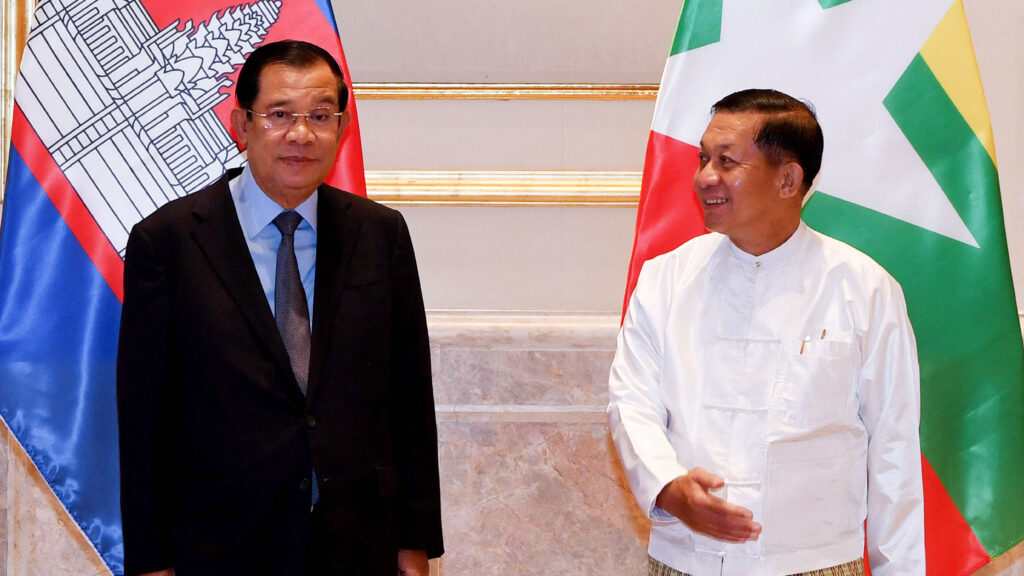
Myanmar President to Hold Talks with Cambodian Leaders on State Visit
Myanmar President U Min Aung Hlaing will undertake a state visit to Cambodia from September 11-12. He is scheduled to meet with Acting Head of State Hun Sen and Prime Minister Hun Manet to discuss strengthening bilateral ties, economic cooperation, and regional dialogue within ASEAN.
This article requires PRO
This article is outside the free access window or is a special report. PRO unlocks it and the full archive.
Related articles
- Myanmar President Backs Cambodia's Peaceful Resolution of Border Dispute with Thailand
Myanmar's President Min Aung Hlaing has declared full support for Cambodia's stance on resolving the Cambodia-Thailand border dispute peacefully, in accordance with international law and existing mechanisms. This was announced following a summit between Cambodia's Acting Head of State Hun Sen and the Myanmar President.
- Cambodia Welcomes Myanmar President on State Visit, Affirms Strengthening Bilateral Ties
Cambodian Acting Head of State Hun Sen hosted Myanmar President Min Aung Hlaing on a state visit, reaffirming the long-standing friendship and close partnership between the two nations. Both countries agreed to deepen cooperation across various sectors including economy, tourism, and culture.
- Myanmar President Backs Peaceful Resolution of Cambodia-Thailand Border Dispute
Myanmar's President Min Aung Hlaing has expressed strong support for Cambodia's stance on resolving the Cambodia-Thailand border dispute peacefully, in accordance with international law. During a meeting with Senate President Hun Sen, he voiced support for Cambodia's position and expressed hope for the normalization and stabilization of the border.
- Myanmar President Backs Cambodia's Stance on Thai Border Dispute Resolution
Myanmar President U Min Aung Hlaing has fully supported Cambodia's position to resolve border disputes with Thailand peacefully and in accordance with international law, during a meeting with Senate President Hun Sen. Cambodia claims Thai occupation of its territory.